5.0 Excellent
Your Ultimate First-Time Safari Guide
A first-time safari in Tanzania is a guided trip into wildlife country. Choose a route that fits your dates, leave time between parks, and book camps close to your game drives. Animal sightings are never guaranteed.
Your first trip need not cover every famous park. A few well-chosen stops can give you more time to watch wildlife and less time on the road. This guide helps you compare routes, plan costs, choose where to sleep, and prepare for the bush.
Entry and health information checked: 30 September 2026. Rules can change. Check the official guidance again before departure, especially if your trip includes Zanzibar or a flight through another country.
How should you plan a first-time safari?
Start with your dates, available days, and budget. Then choose one safari region and a pace you can enjoy. Build the route around those choices, rather than adding parks until the map looks full.
Decide how many nights you can spend on safari, apart from arrival and beach nights.
Choose your main interest: varied wildlife, the migration, birdlife, scenery, or quiet time in camp.
Compare a private trip with a shared departure.
Select a sleeping style and check the exact camp names.
Ask for a written route, total price, and clear list of what is not included.
Review flights, entry rules, health advice, and insurance before paying.
For a first-time safari, comfort is not only about a large room. It also means a sensible daily pace, a good seat in the vehicle, and time to rest. Tell your planner if you dislike long drives or need frequent stops.
Why choose Tanzania for your first-time safari?
Tanzania offers several distinct safari regions. In the north, you can combine open plains, a volcanic crater, woodland, and lakeside scenery. That variety helps a new visitor see how different habitats shape each game drive.
The northern circuit can suit travellers who want a road trip with several parks. A southern route may suit a trip that starts on the coast. Neither is the right choice for everyone. Flight costs, camp location, and the time you have all matter.
Think of a first-time safari as a chance to learn, not a hunt for a checklist. A guide can explain tracks, bird calls, and the role of each animal. A herd at a waterhole can be just as moving as a lion sighting.
Which parks suit a first-time safari?
Choose parks for their habitats and their place on your route. Do not add a distant stop just for one animal. A park with more time on the ground often serves you better than a rushed extra visit.
What does Serengeti National Park offer?
The Serengeti offers wide plains, varied wildlife, and the Great Migration. It is a large park, so your camp's location matters. One booking described as “Serengeti” may place you far from another.
For migration-focused travel, match your dates with the region where herds may be found. Ask which area your camp serves and why it fits the season. A camp chosen for one month may not serve the same purpose later.
Do not judge a Serengeti visit only by river crossings. Herd movement changes with conditions, and crossings do not run to a timetable. Give yourself time to explore other wildlife too. Read the official Serengeti park information when comparing plans.
Why include Ngorongoro Crater?
Ngorongoro Crater offers a striking change of scenery within a volcanic caldera. Its grasslands and wetlands support a range of wildlife, including black rhino. A rhino sighting, however, is never a promise.
A crater visit can form part of a northern route. Ask whether your stay is on the rim or in the Karatu area. Compare the drive to the descent gate, room comfort, and price. See the Ngorongoro authority's attraction guide for the setting.
Why choose Tarangire or Lake Manyara?
These parks add different landscapes to a northern trip. Choose one or both according to your time and interests. They should add depth to your first-time safari, not just another name on the route.
Tarangire is known for elephants, baobab trees, and the Tarangire River. Lake Manyara adds forest and lakeside habitats, with monkeys and birdlife among its attractions. Tree-climbing lions are possible at Manyara, but seeing that behaviour is not guaranteed.
Check current access and the planned route within each park. Lake conditions and wildlife movement can change the experience. Ask what your guide hopes to explore, rather than treating a brochure photo as a fixed scene.
Should you choose the north or south?
For a first-time safari, choose one region unless you have ample time and budget. Linking distant parks can add flights, road days, and cost. It may leave less time for the wildlife you came to see.
A northern plan often centres on Arusha and the parks above. A southern plan may focus on Nyerere or Ruaha. Ask for a separate southern proposal if your trip starts in Dar es Salaam or your main goal is that region.
Compare complete routes, not single camp prices. Look at arrival flights, transfers, park nights, and your onward journey. If you want both regions, ask how many travel days the combination requires.
How many days does a first-time safari need?
Five to seven full safari days can make a useful starting point for a northern route. This is planning advice, not a fixed rule. Your park choices and tolerance for road travel should set the final length.
Two or three safari days: focus on a compact route rather than trying to reach every major park.
Four or five days: keep the park list short and check how much time transfers use.
Six or seven days: allow more time in one key park and avoid changing camp every night.
Eight days or more: consider slower stays, a second region, or beach time without rushing the core route.
Count full wildlife days separately from arrival days. A late flight followed by a hotel night is not a full safari day. Likewise, a long drive between camps is not the same as a day spent exploring one park.
For your first-time safari, request a day-by-day plan that shows these differences. Two quotes with the same number of nights may give you very different amounts of game-viewing time.
What could a seven-day northern route look like?
This sample starts in Arusha and combines Tarangire, Serengeti, and Ngorongoro. It is a route idea, not a live offer. Your flight times, chosen camps, season, and road conditions may require changes.
Day 1 — Arrive and rest: transfer to your Arusha hotel, check luggage, and meet your planner or guide. Keep the evening light.
Day 2 — Explore Tarangire: take a game drive, then stay at the camp or lodge shown in your quote.
Day 3 — Travel towards Serengeti: allow a substantial part of the day for the journey. Any game viewing depends on the route and arrival time.
Day 4 — Stay in Serengeti: explore from the same camp. Discuss the day's focus with your guide.
Day 5 — Enjoy another Serengeti day: leave room for patient watching and a different area, rather than rushing onward.
Day 6 — Move towards Ngorongoro: travel to the confirmed rim or Karatu property. Rest before the crater visit.
Day 7 — Visit the crater and return: plan the descent and onward drive with your guide. Add an Arusha night where needed.
Do not attach a tight international flight to the final road day without advice. A buffer night can protect your departure and make the end of the trip calmer. Confirm whether that night and the airport transfer are in the price.
Drive times depend on the gate, camp, stops, and road conditions. Ask for realistic estimates for your actual properties. A map's shortest route may not be the route a safari vehicle can use.
When is the best time for a first-time safari?
The best month depends on the park and the experience you want. Tanzania has local climate differences. Choose your route and camp with the season in mind, rather than assuming one month is best everywhere.
June to October is broadly the dry season. March to May is generally the long-rain period, while November and December often bring shorter rains. These are broad patterns, not a forecast for your exact dates. See TANAPA's trip-planning guidance.
January and February can suit a trip focused on calving in the southern Serengeti ecosystem. A northern Serengeti camp is not a substitute for a camp near that seasonal focus. Ask the planner to explain the location.
Rain can affect roads and some camp schedules. Check that your chosen property will be open and that your route is practical. A lower room rate does not help if the plan no longer fits your goals.
For a migration-focused first-time safari, build in flexibility. Weather influences herd movement. No month, lodge, or guide can guarantee a particular crossing or predator encounter.
How much does a first-time safari cost?
The price depends on the route, dates, group size, camps, and transport. Ask for a dated quote in a named currency. A headline price means little until you know exactly what it covers.
A private vehicle costs more per person when fewer guests share it. Flying to a park can reduce road time but adds airfare and baggage rules. A camp's location may also change transfer costs, even if its room rate looks similar.
Compare these items line by line:
Number of nights and exact room or tent type.
Private or shared vehicle, number of guests, and seat arrangements.
Guide services, game drives, and any limits on the daily schedule.
Park, conservation, concession, and crater fees where relevant.
Meals, drinking water, other drinks, and packed lunches.
Arrival hotel, airport transfers, and internal flights.
Optional activities, tips, laundry, visas, and insurance.
Taxes, payment charges, deposit terms, and cancellation rules.
Ask whether the total is per person or per group. Check for single-room supplements and child pricing. Also ask what happens if a named camp is unavailable. A substitute should not quietly change the route or standard you chose.
Set a total trip budget beyond the safari quote. Include flights from home, insurance, visas where needed, personal spending, and any beach stay. Keep some room for costs that are not part of the package.
Should your first-time safari be private or shared?
A private trip gives your party more control over pace and stops. A shared trip can spread vehicle costs across guests. Compare the actual terms; neither label alone tells you the quality of the trip.
Private travel may suit families, photographers, and guests who need more rest. It lets you discuss priorities without balancing several separate parties. However, park rules and camp schedules still apply. A private booking does not mean unrestricted access.
For a shared departure, ask about the maximum group size, vehicle seats, dates, and camp style. Check whether departure depends on enough guests booking. Understand what happens if the group does not fill.
Tell your planner if photography is central to your first-time safari. Ask about space for equipment and time spent at sightings. A window seat, viewing roof, and unhurried schedule may matter more to you than a long park list.
Should you sleep in a lodge, tented camp, or campsite?
Choose by the actual facilities and location, not the name alone. A serviced tented camp can have beds and a private bathroom. Basic camping is a different experience, with different expectations for comfort.
What should you check before choosing a room?
Ask for the exact property and room category. Then check the facilities that affect your day. Photos can help, but they may show a different room or a view that is not available to every guest.
Private or shared bathroom, and the type of hot-water supply.
Power hours, charging points, and any limits on equipment.
Distance from parking to the room, steps, and paths after dark.
Meal times, food needs, drinking water, and laundry arrangements.
Drive time to the park gate or planned game-viewing area.
If you choose basic camping, check who sets up the tent and what bedding is supplied. Ask about shared washrooms, meals, and wet-weather arrangements. TanzaLux's camping safari options provide a starting point for that discussion.
A first-time safari can work at several comfort levels. Spend where it improves your own trip. A well-placed camp with enough nights may offer more value to you than a costly room reached after a rushed drive.
What happens on a typical game-drive day?
Your day follows the park rules, chosen route, and wildlife conditions. Some plans start early and return to camp for a break. Others use a packed lunch and spend longer out in the vehicle.
Ask your guide about the plan before leaving. Agree on comfort stops, meal timing, and how long the drive may last. Tell them early if you feel tired or unwell. It is easier to adjust before a long stretch on the road.
Wildlife watching involves quiet waiting as well as driving. A cat may sleep for a long time. A shy animal may stay in cover. Use those pauses to watch birds, scan nearby bushes, or learn why the guide chose that spot.
For a first-time safari, keep an open mind about what makes a good day. Do not pressure a guide to speed or crowd an animal. Responsible viewing helps protect both the wildlife and your experience.
What should you pack for a first-time safari?
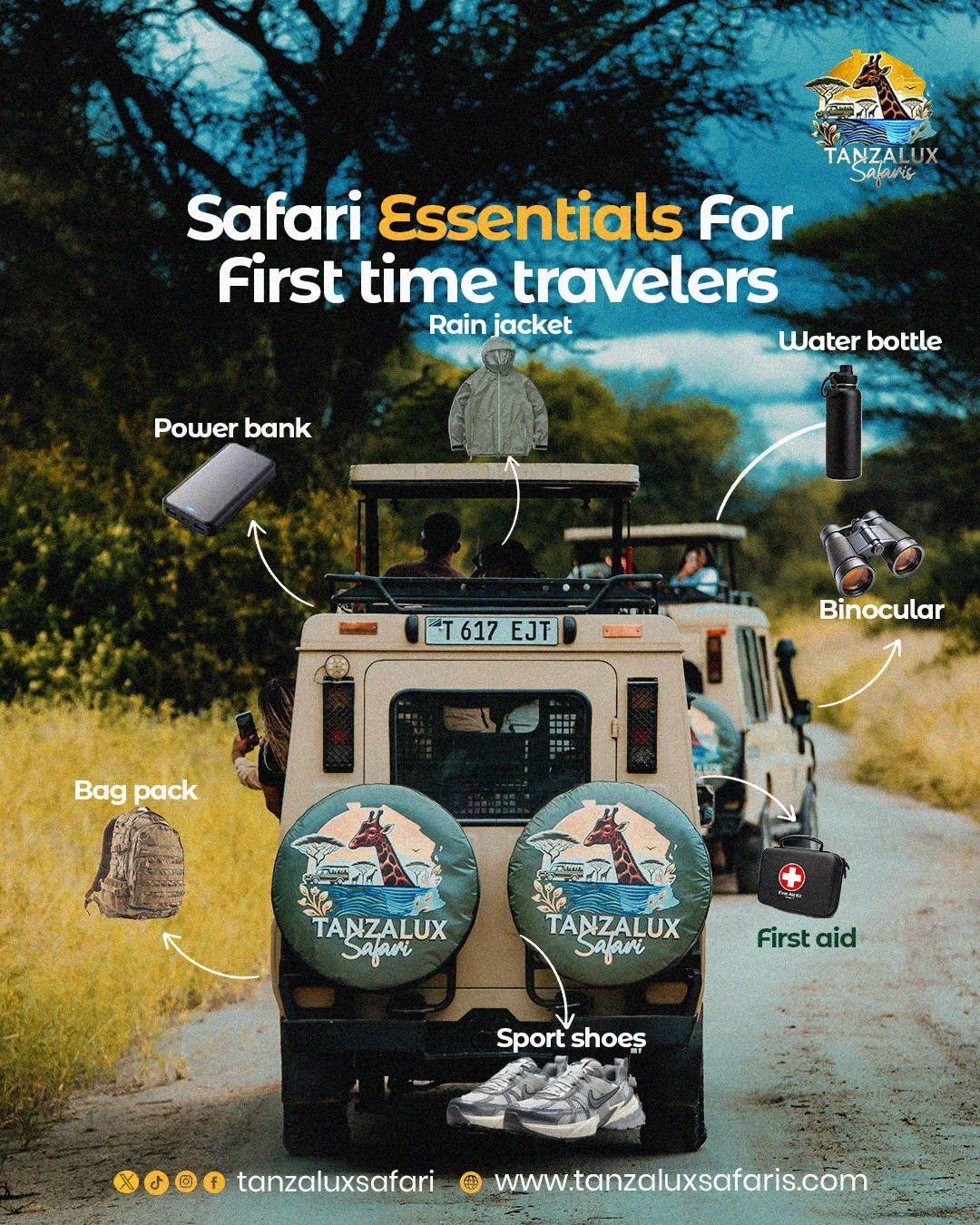
Pack light, with layers for cool starts and warm afternoons. Choose clothes you can wear more than once. Check the luggage rules for every flight before buying a bag or packing camera gear.
Light shirts, long trousers, a warm layer, and a rain layer.
A hat, sunglasses, sunscreen, and comfortable closed shoes.
Binoculars, camera batteries, spare memory cards, and a power bank.
Insect repellent, prescribed medicines, and a small personal wash kit.
Travel documents, insurer contacts, and offline copies of your itinerary.
Put medicines and vital documents in your hand luggage. Keep a change of clothes there too in case your main bag is delayed. Label bags clearly and avoid carrying gear you will not use.
For light-aircraft flights, confirm the allowance with the actual carrier. Ask whether the limit includes hand luggage and whether soft-sided bags are required. Do not assume an international baggage allowance applies to a small safari aircraft.
Ask before bringing a drone. Tanzania requires advance permissions, and parks have separate controls. A guide cannot simply approve its use on arrival. Check the Tanzania Civil Aviation Authority's drone procedures before packing one.
What entry, health, and insurance checks should you make?
Check requirements for your nationality and full route before travel. Include transit countries and any Zanzibar stay. A safari quote does not replace immigration advice, a travel-health consultation, or the terms of an insurance policy.
How should you check passport and visa rules?
Use Tanzania's official immigration service to confirm the rules for your passport. Visa eligibility differs by nationality. Do not assume a visa on arrival is available to everyone.
Check passport validity, blank-page requirements, and return or onward travel evidence. If your nationality needs a referral process, allow the required time before booking firm travel. Start with the official Tanzania visa guidelines.
What health advice do you need?
Arrange a travel-health consultation well before departure. Share your route, age, health needs, and transit stops. Ask about recommended vaccines, malaria prevention, and steps to reduce insect bites. Use the NaTHNaC Tanzania health guide to prepare your questions.
Yellow fever certificate rules depend on your arrival country and certain transit routes. They are not a blanket requirement for every traveller. Have a qualified clinician review your full flight plan and current rules. See the CDC's Tanzania travel-health advice.
Discuss medicine storage and access to care if you have a health condition. Carry enough prescribed medicine for the trip and possible delays. Tell your planner about practical needs, without assuming every remote camp has the same support.
What insurance is required from October 2026?
From 1 October 2026, eligible foreign visitors entering through mainland Tanzania must obtain NIC inbound insurance. Entry through Zanzibar uses ZIC. Check the official rules for your arrival route, eligibility, and policy terms.
The official Ministry of Finance notice explains the entry-route approach. The NIC FAQ lists an exclusion for residents of EAC and SADC states. Confirm the rules before travel; do not assume a combined itinerary always requires two policies.
Also review your wider travel cover for safari activities, emergency evacuation, trip cancellation, and personal belongings. Required inbound cover may not meet every need. Read exclusions and save the assistance number where you can reach it offline.
How can you travel safely and responsibly?
Follow your guide's wildlife instructions and the camp's safety briefing. Read your government's current travel advice before booking and again before departure. Avoid blanket claims that any destination or activity is risk-free.
Remain in the vehicle unless your guide directs you to a permitted place. Never feed wildlife or ask to leave marked routes. At camp, use an escort when required and do not walk out to investigate animal sounds.
Keep valuables discreet in towns and arrange transport through trusted providers. Save key contacts and share your itinerary with someone at home. The UK government's Tanzania travel advice is one official starting point; use advice relevant to your own nationality too.
For community visits, ask how the visit is arranged and whether it is optional. Seek consent before taking portraits. Avoid giving gifts to children or buying wildlife products. Respectful travel is about how you behave, not just a label on a package.
Ask about access before booking your first-time safari. Vehicle steps, rough roads, room paths, and toilet stops may matter. A private trip can help with pacing, but it does not make every camp or activity accessible.
Why plan your first-time safari with TanzaLux Safaris?
TanzaLux Safaris can help turn your priorities into a practical Tanzania route. The useful starting point is a clear brief: dates, travellers, budget, sleeping style, and the experiences you most want.
Explore our Tanzania safari options, then ask for a tailored proposal. Compare private and shared choices, camping and lodge stays, and road and flight routes. Your plan should show where you will sleep and how each day works.
Before confirming, ask us to explain:
Why the selected parks and camps fit your travel dates.
How much time is set aside for travel, game drives, and rest.
The exact inclusions, exclusions, total price, and payment terms.
Which requests have been confirmed and which remain subject to availability.
Who to contact before travel and during the trip.
Ready to plan your first-time safari? Contact TanzaLux Safaris with your dates, group size, and preferred pace. Share the questions you still have. A strong plan starts with clear answers, not a promise of guaranteed wildlife.
20 frequently asked questions about a first-time safari
These answers cover the common choices and checks before you book. Use them alongside your final itinerary and current official guidance. The right details depend on your route, dates, and personal needs.
1. Is Tanzania a good choice for a first-time safari?
Tanzania can suit a first-time safari, with several routes and sleeping styles to choose from. The best choice depends on your interests and budget.
Start with one region and enough time in each main park. A focused route is often easier to enjoy than a trip that tries to cover the whole country.
2. How many safari days should I book?
Five to seven full safari days is a useful planning range for a northern route. Shorter trips can work if you keep the park list small.
Count arrival and departure days separately. Ask how much of each safari day is spent travelling between camps, rather than watching wildlife.
3. Which parks should I choose first?
Choose parks that fit your dates and route. Serengeti, Ngorongoro, Tarangire, and Lake Manyara offer different habitats, but you do not need to visit all four.
Tell your planner what matters most. Migration interests, birdlife, road tolerance, and camp comfort can lead to different choices.
4. Will I see all of the Big Five?
No operator can guarantee all five. Lions, leopards, elephants, buffalo, and rhinos live in the wild, and sightings depend on many factors.
Do not measure your first-time safari only by that list. Time spent watching less famous species can be just as rewarding.
5. What is the best month for my first-time safari?
The best month depends on your chosen parks and goals. Match the season with the route, then check camp location and access.
A trip focused on calving needs a different location from one focused on possible river crossings. Broad seasonal advice is not a forecast.
6. Can I be sure of seeing a migration river crossing?
No. Herds move with changing conditions, and a crossing can happen when you are elsewhere. It may also not happen during your stay.
Choose a suitable region and allow time, but enjoy the rest of the wildlife too. Avoid offers that promise a crossing as certain.
7. How do I compare safari prices fairly?
Compare the same dates, route, camps, room types, and group size. Ask for one total in a named currency, with a clear list of inclusions.
Check flights, fees, drinks, tips, transfers, and any single-room charge. A cheaper headline can hide a different trip or more costs later.
8. Is a private or shared safari better for beginners?
Private travel suits guests who want more control over pace. Shared trips may reduce the cost per person. Check the specific offer rather than relying on the label.
Ask about seat space, group size, departure rules, and how daily decisions are made. The answer should fit your own first-time safari priorities.
9. Is a tented camp the same as basic camping?
No. A serviced tented camp may provide a bed and private bathroom. Basic camping normally involves a simpler tent and different washroom arrangements.
Confirm the exact facilities, bedding, meals, and setup support. Judge the property by what is included, not just the word “tent.”
10. What clothes should I bring?
Bring light layers, long trousers, a warm top, and a rain layer. Add a hat and comfortable shoes. Choose practical clothes you can wear more than once.
Check whether laundry is available and what it costs. Avoid filling your bag with a new outfit for every day.
11. What luggage can I take on a safari flight?
Use the allowance set by your booked carrier. Confirm the weight limit, bag shape, and whether hand luggage is included.
Tell the airline about bulky camera gear before travel. Do not apply your long-haul flight's allowance to a light-aircraft service.
12. Which arrival airport should I book?
Book the airport named in your final itinerary. Northern routes commonly use an Arusha-area arrival plan, while a coastal start needs a different transfer plan.
Check the airport code, flight date, arrival time, and transfer cost with your planner. Do this before buying non-refundable tickets.
13. Do I need a visa for Tanzania?
Visa rules depend on your nationality and purpose of travel. Check the official Tanzania Immigration guidance before departure.
Some travellers need extra advance approval. Do not assume everyone can obtain a visa on arrival, or use another person's experience as your rule.
14. Is a yellow fever certificate required?
It depends on where you arrive from and certain transit routes. A certificate is not a blanket requirement for every visitor.
Have a travel-health professional check your complete flight itinerary against current entry rules. Ask about any medical exemption process if it applies to you.
15. Should I ask about malaria prevention?
Yes. Share your full Tanzania itinerary with a qualified travel-health clinician. Ask about prevention suited to your route and health needs.
Do not assume a lodge stay removes the risk. Follow advice on insect-bite protection and prescribed prevention, and seek medical advice promptly if unwell.
16. Do I need compulsory inbound insurance?
Check your eligibility and entry route. From 1 October 2026, eligible foreign visitors entering mainland Tanzania use NIC inbound cover; entry through Zanzibar uses ZIC.
Confirm current exemptions and policy terms with the official provider. Review your wider travel insurance too, rather than assuming mandatory cover meets every need.
17. Can children or guests with access needs join?
They may be able to, with a suitable route and confirmed arrangements. Check each property's facilities and each activity's age rules before booking.
Discuss vehicle access, steps, toilet stops, food, and rest needs. A private first-time safari can help with pace, but it is not a promise of step-free access.
18. Will I have Wi-Fi and phone signal?
Do not rely on constant coverage. Ask each property about its current Wi-Fi and charging setup, then download important details before departure.
Save your itinerary, tickets, and emergency contacts offline. Tell people at home that replies may be delayed while you are in remote areas.
19. Are tips included in the safari price?
Check your quote. Tips may be separate from the package price. Ask for guidance on the roles you may wish to tip and a practical payment method.
Budget for them before travel without treating a suggested amount as a fixed fee. Keep package inclusions and personal spending clearly separate.
20. How do I book a first-time safari with TanzaLux?
Send TanzaLux your dates, group size, budget, and main interests. Mention any needs that affect driving time, rooms, meals, or access.
Review the written itinerary, named camps, total price, and booking terms. Confirm what is available before paying, and keep a copy of the agreed plan.
.jpg?alt=media&token=95a5caed-fa4c-47ac-a42e-c42ac61e6b69)
Ready to start planning?
Tell us your dates and what you're after — no obligation.