5.0 Excellent

How Fast Can a Wildebeest Run?
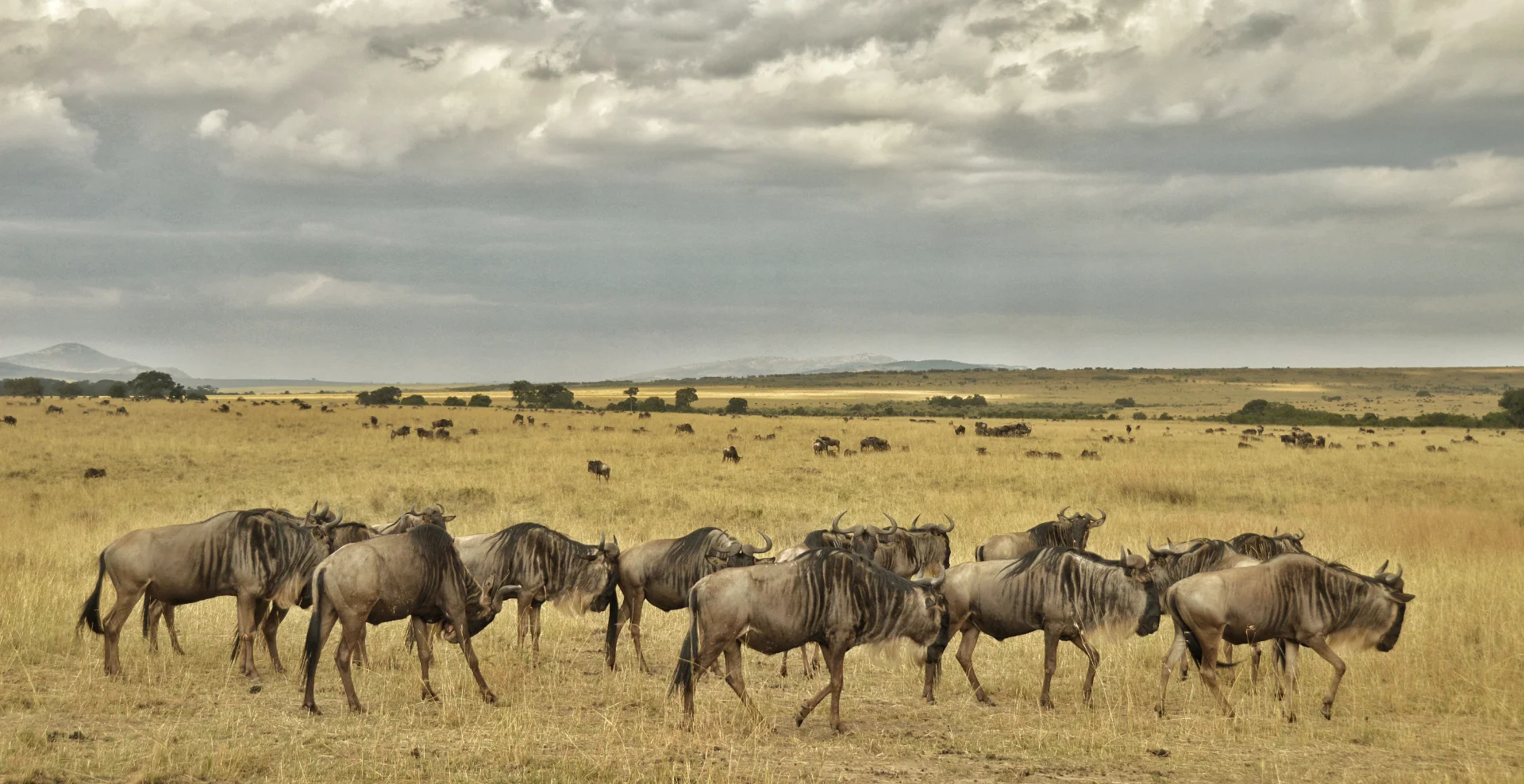
A wildebeest can run at a commonly quoted top speed of about 80 km/h, or 50 mph. Zoo de Granby's blue wildebeest profile gives this upper figure. Treat it as an approximate sprint capability, rather than the pace of every animal you see on safari.
Wildebeest speed is impressive, but it tells only part of the story. On the Serengeti plains, you may watch a herd graze, walk in a loose line, pause or break into a run. Each scene shows a different part of how these animals live.
This guide explains wildebeest running speed, how to understand it and what to look for on a Tanzania safari. You will also find advice for viewing and photography, sample packages and answers to common questions.
Plan a private safari with TanzaLux Safaris and spend time watching the wildebeest herds.
Wildebeest speed: the quick facts
Keep wildebeest top speed separate from everyday travel. The Great Migration is a story of feeding, movement and changing seasons as well as bursts of fast action.
Commonly quoted top speed: about 80 km/h.
In miles per hour: about 50 mph.
In metres per second: about 22.2 m/s at that same speed.
What the figure means: an approximate upper running capability.
What it does not tell you: a fixed everyday pace, exact sprint duration or the speed of a newborn calf.
Those units describe the same rate of movement. They do not represent three separate records. The rounded figures are useful for scale, without suggesting that a wild animal runs like a vehicle set to a fixed speed.
For safari guests, the most useful distinction is between a short fast run and the much broader pattern of movement across the landscape.
How fast can a wildebeest run in mph and km/h?
To convert kilometres per hour to miles per hour, divide by about 1.609. An 80 km/h figure becomes roughly 49.7 mph, which is usually rounded to 50 mph.
The International Fund for Animal Welfare's wildebeest guide also cites 80 km/h, or 50 mph. This agreement makes it a useful headline figure, but neither a rounded fact sheet nor a safari sighting is a measured race result for every animal.
When reading about wildebeest speed, look for words such as “up to” and “about.” They keep the claim in context. An animal's age, condition and the situation matter when you watch it move.
You do not need a speed reading to enjoy the scene. Notice how quickly a gap closes, how the herd changes shape and when the animals settle again. Those details make the sighting richer than a number alone.
Does wildebeest speed stay constant for an hour?
No. A speed expressed “per hour” is a unit, not a claim about duration. A brief burst can be expressed in km/h even when it lasts only seconds.
This is an important part of explaining wildebeest speed. A top-speed figure does not establish how long an animal can keep it up. It also does not give its average speed over a day or its migration.
A simple maths example helps. At a constant 80 km/h, covering 100 metres would take about 4.5 seconds. That calculation assumes the animal is already at that speed and holds it throughout. It is not a recorded wildebeest 100-metre time.
On safari, resist the urge to turn a brief view into a precise measurement. Distance, camera angle and a moving vehicle can change how fast an animal appears.
What explains wildebeest speed?
A wildebeest's shape can look unusual at first: a broad head, sloping shoulders and a sturdy front end above comparatively slender legs. Yet it is a member of the antelope family, built for life in open country.
Zoo de Granby's profile links its running ability with powerful muscles and stamina. That provides a better picture than assuming the animal is slow because of its bulky appearance.
Watch the whole movement rather than just the legs. You may see the head position shift, the body rise and fall and the space between animals change. These are useful details to discuss with your guide while observing from a respectful distance.
Wildebeest speed is one part of survival. The animals also live in groups, remain alert and use the landscape. None of those features makes an individual invulnerable.
Can a wildebeest outrun a lion or another predator?
A chase is not decided by a speed chart alone. The starting distance, direction, footing and moment of detection all affect what happens. So do the condition of the animals and the choices made during the chase.
The African Wildlife Foundation lists lions, cheetahs, wild dogs and hyenas among wildebeest predators. That does not mean each predator tackles every animal in the same way.
It is reasonable to think of wildebeest speed as one escape tool, rather than a guarantee. A fast animal may still face danger if surprised or separated. A herd can be worth watching even when nothing is running.
For guests, a quiet pause can reveal the most interesting part of the story. Ask your guide what the herd seems to be watching and which parts of the landscape deserve attention. Avoid expecting every encounter to end in a hunt.
Why do wildebeest gather in herds?
San Diego Zoo Safari Park describes large herds as protection against predators and notes their need for grass and water. The moving mass has a practical purpose, not just visual drama.
In a group, there are more animals scanning the surroundings. Zoo de Granby also describes this advantage of many watchful eyes. Herd life and wildebeest speed work together as parts of a wider survival story.
A good viewing exercise is to choose one small section of the herd. Watch which animals graze, which lift their heads and how they respond when others move. Then look up and see the shape of the whole group.
This way of watching turns a distant line of dark shapes into a scene full of detail. You may find a calm herd just as absorbing as a sudden burst of action.
Do wildebeest run throughout the Great Migration?
No. The Great Migration is a seasonal pattern of movement in search of grazing and water. It is not one continuous sprint around a circuit.
AWF describes the Serengeti herds as following food and water over a long annual journey. That broad movement is a different measure from maximum running speed. Travel takes place through a landscape that changes with the rains.
When considering wildebeest speed during migration, separate three things: the pace of one animal, the movement of a group over a short period and the changing location of herds across weeks. A migration map addresses the last of those.
Allow time to see more than one scene. A morning of grazing, a line moving through the plains and a resting group can help you understand the journey without needing a dramatic event.
How quickly can newborn calves move?
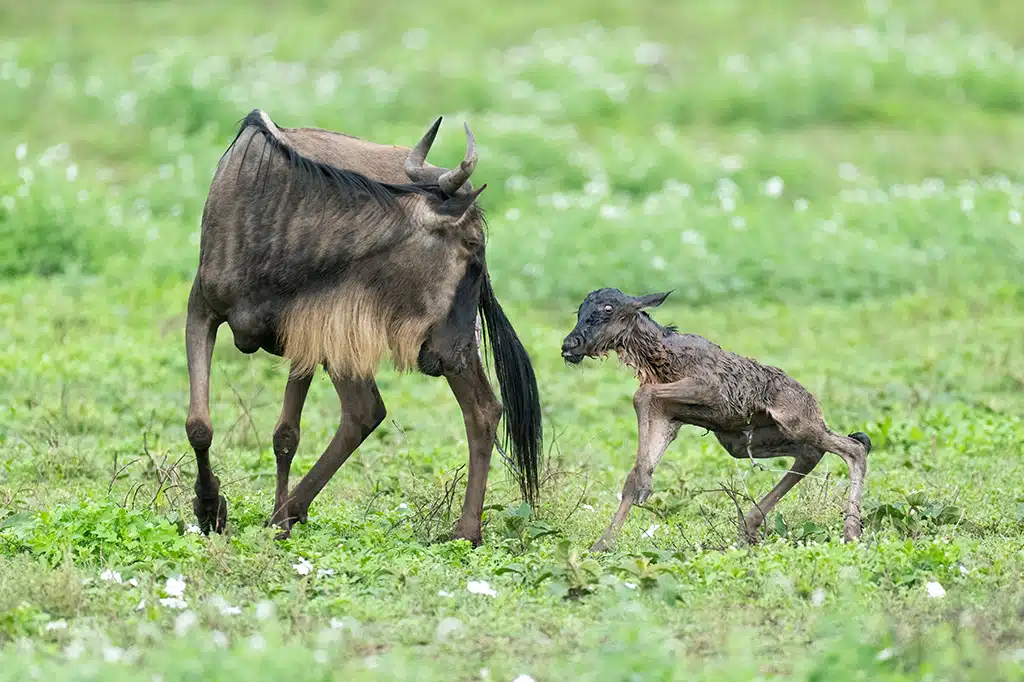
Calves become mobile remarkably soon after birth. The Serengeti park authority's migration facts describe mobility within about three to seven minutes, with calves able to follow the herd soon afterwards.
That is not a measured top speed for a newborn. Do not apply the adult headline figure to calves. Early movement and adult sprinting ability are different facts.
A calving-season sighting can show the bond between mother and calf, first steps and a gradual move back toward other animals. Give the pair room and let your guide judge the best place to wait.
Wildebeest speed may draw your interest, but a calf's first careful steps can be just as memorable. There is no need to hurry the scene or seek a closer view.
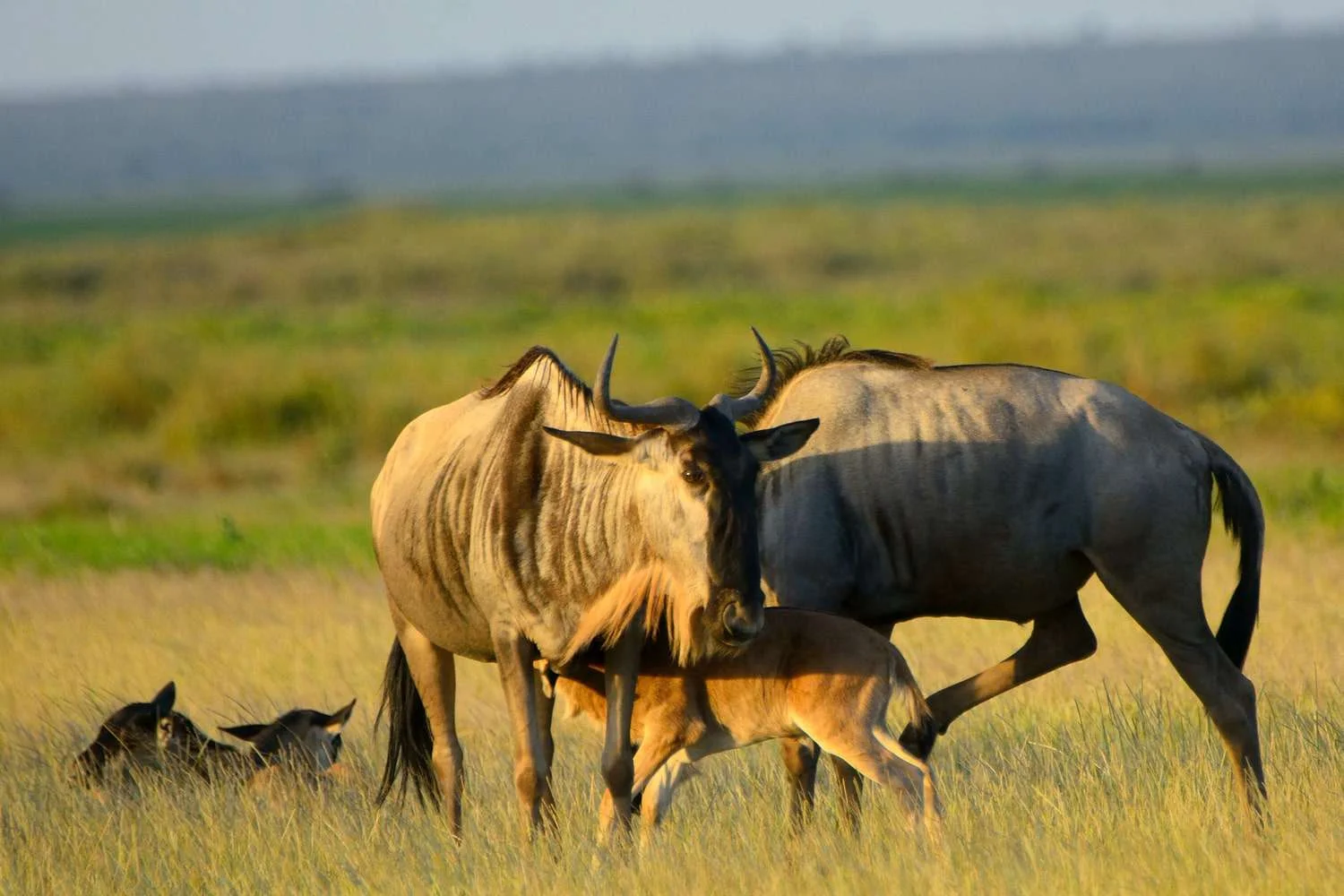
A calf stays close to adults. A photograph shows one moment; it does not measure the animal's running speed.
Where can you watch wildebeest in Tanzania?
The Serengeti ecosystem is the main focus for a migration-led trip. The right base depends on your dates and interests, so plan the region before choosing a room style.
The large Serengeti–Mara herds are western white-bearded wildebeest, as described by AWF. These belong to the common wildebeest species, Connochaetes taurinus, often called blue wildebeest in general safari guides.
Southern plains and Ndutu area: discuss an early-year trip if calves and open-plains scenes are your main interest.
Central Serengeti: consider a base that fits a broader wildlife route.
Western Corridor: discuss it for the mid-year movement toward the Grumeti area.
Northern Serengeti: consider the broad July-to-October window for Mara River crossing interests.
These are seasonal planning guides, not promises of herd locations. Nomad's migration camp guide explains how weather affects herd movements and why fixed maps cannot predict every season.
A safari about wildebeest speed does not require animals to run on demand. Choose a well-placed base, allow several nights and enjoy the range of behaviour you encounter.
Ask TanzaLux which Serengeti region suits your dates and wildebeest-viewing interests.
What should you expect at a river crossing?
A river crossing is different from a run across dry plains. Water, banks and the movement of other animals change the situation. A land-speed figure cannot tell you a swimming speed or how long a crossing will take.
You may spend a long time waiting, and the herd may move away without entering the water. Build a northern stay around more than one possible event. Your guide can use the time to explore other wildlife as well.
The park's crossing guidance requires designated viewing areas, stationary vehicles during crossing situations and clear space for animals. Follow those rules and your guide's instructions. A good view never justifies blocking the herd.
Never ask a driver to chase animals to demonstrate wildebeest speed. Your role is to watch a natural event while giving wildlife space.
Photographing wildebeest speed and movement
Prepare before the action starts. Keep your camera ready, check battery and storage, and ask your guide where light and a clear view may work best. Stay within your vehicle and the area's rules.
For sharp action: use a fast shutter speed and test it on nearby movement.
For focus: practise your camera's continuous focus and tracking modes before the trip.
For motion blur: try a slower shutter with a smooth pan when the scene allows.
For scale: leave space around the herd instead of framing every shot tightly.
For variety: capture grazing, lines of movement, calves and the wider landscape.
No single setting fits every camera, lens or light level. Review a few frames while the scene is calm. A private photography-focused drive can leave more time to work patiently, subject to the route and park rules.
Wildebeest speed can make action hard to frame, so a simple plan helps. Decide whether you want a close detail, a small group or the whole scene before pressing the shutter.
Tips for a richer wildebeest safari
Tell your planner what interests you most. Births, movement, herd size and photography can call for different routes. “I want to understand the herds” is a useful brief alongside your travel dates.
As a planning suggestion, allow at least three nights in a chosen base when your schedule permits. That gives more than one full day between arrival and departure. Add time when visiting widely separated regions.
Keep expectations open. A quiet wildlife day can still bring good light, new questions and small details. Your guide can help interpret what you see without promising a chase or crossing.
Bring binoculars so you can watch comfortably from a distance. If travelling with children, turn wildebeest speed into a learning question, then look at food, movement and family groups as well.
Sample packages for watching the herds
These are sample route ideas, not fixed offers or live prices. Exact camps, permissions, transport and services need a dated quote. Choose your base for the season, then tailor the pace to your group.
Sample package: 7-day classic Serengeti wildlife safari
Day 1: arrive and stay in Arusha.
Day 2: explore Tarangire and continue to a suitable Karatu-area stay.
Day 3: travel to Central Serengeti through the Ngorongoro area.
Days 4–5: enjoy two full game-drive days from one Serengeti camp.
Day 6: return toward Ngorongoro and stay nearby.
Day 7: visit the crater and transfer onward, adding a night if required for your flight.
Good fit: a first private Tanzania safari with three Serengeti nights. The route offers time for general wildlife as well as watching herds when they are within reach.
Build a 7-day private wildlife safari with TanzaLux Safaris.
Sample package: 8-day southern plains and calving safari
Day 1: arrive and stay in Arusha.
Day 2: visit Tarangire and stay in the Karatu area.
Day 3: travel to a seasonal southern plains or Ndutu-area base.
Days 4–5: explore nearby plains, with time to watch calves and herd life.
Day 6: return toward the Ngorongoro highlands.
Day 7: visit the crater and spend another night nearby.
Day 8: return to Arusha or your confirmed departure point.
Good fit: early-year interests, with three southern nights. Exact camp location and natural conditions shape the experience; births and specific animal behaviour cannot be scheduled.
Plan a southern Serengeti and Ndutu safari around your travel dates.
Sample package: 10-day central and northern migration safari
Days 1–2: arrive in Arusha, then travel toward the Karatu area.
Days 3–4: spend two nights in Central Serengeti.
Day 5: travel to a northern camp.
Days 6–7: explore the north, with river viewing when conditions suit.
Day 8: start the road return with a central overnight stop.
Day 9: continue to the Ngorongoro or Karatu area.
Day 10: return to Arusha for a suitably timed connection.
Good fit: a broad northern migration window and guests comfortable with long road transfers. This version has three northern nights and no crater descent; add time if you want to include one.
Request a central and northern Serengeti route from TanzaLux Safaris.
Why travel with TanzaLux Safaris?
TanzaLux is Tanzanian-owned and based in Arusha. The team plans trips around dates, pace, budget and interests. Its private safari service offers your own vehicle and guide on a tailored route.
That is useful if wildebeest speed has sparked a wider interest in the herds. Explain whether you most want to see calves, photograph movement or explore the migration landscape. Ask why each proposed camp suits that goal.
A private plan also gives your party scope to discuss time at sightings and breaks between drives. Confirm the exact services in your quote and allow enough nights to enjoy the place you have chosen.
Turn your wildlife questions into a tailored Tanzania safari with TanzaLux Safaris.
Frequently asked questions
1. How fast can a wildebeest run?
A commonly quoted top figure is about 80 km/h, or 50 mph. Treat it as an approximate upper sprint capability, rather than a speed every animal will reach in every situation.
2. What is wildebeest speed in miles per hour?
About 50 mph corresponds to the usual 80 km/h figure. The conversion is rounded; it is not a separate measurement.
3. How many metres per second is 80 km/h?
It is about 22.2 metres per second. Divide kilometres per hour by 3.6 to get metres per second.
4. Can a wildebeest run at top speed for an hour?
The unit km/h does not mean it holds that speed for an hour. A top-speed figure alone gives no exact duration.
5. Is 80 km/h the normal migration pace?
No. Maximum running ability and the herd's progress through the landscape are different things. Migration includes feeding, pauses and movement at different paces.
6. Are wildebeest antelopes?
Yes. Wildebeest belong to the antelope group within the cattle family, Bovidae. Their heavy-looking front end can hide how agile they appear when moving.
7. Which wildebeest form the Serengeti herds?
The great Serengeti–Mara herds are western white-bearded wildebeest, part of the common wildebeest species. General guides often use the name blue wildebeest for this species.
8. Can a wildebeest always escape a lion?
No. A chase depends on more than maximum speed, including starting distance, surprise, footing and the condition of both animals.
9. Why do wildebeest live in large groups?
Herd life offers protection and many watchful eyes. Watching how a small group reacts can reveal more than looking only for fast action.
10. How soon can a calf move after birth?
The Serengeti park authority describes calves becoming mobile in about three to seven minutes. That is early mobility, not a measured newborn top-speed record.
11. Can newborn calves match adult top speed?
Do not assume so. The adult headline figure should not be applied to newborns. This guide does not claim a verified maximum speed for calves.
12. Does running speed tell us swimming speed?
No. Running and swimming are different forms of movement. A land-speed estimate cannot be used to calculate a river-crossing time.
13. When should I visit to see calves?
Discuss an early-year southern ecosystem trip, broadly January to March. The best base depends on dates, rainfall and herd locations. Births cannot be promised.
14. When should I plan for Mara River crossings?
July to October is a broad northern planning window. Stay several nights and enjoy other wildlife too; the herds do not follow a crossing schedule.
15. Will I definitely see wildebeest running?
No particular behaviour can be guaranteed. You may see grazing, resting or walking instead. Those scenes are useful parts of understanding herd life.
16. Can we drive beside a herd to measure its speed?
No. Do not chase, crowd or disturb wildlife. Observe from permitted positions and follow your guide and park rules.
17. What camera setting helps capture a running herd?
A fast shutter and continuous focus can help with sharp action. Test settings for your camera, lens and light, then leave space in the frame for movement.
18. How many nights should I allow for herd viewing?
As a planning suggestion, choose at least three nights in one base when possible. More than one region needs extra time for transfers and full viewing days.
19. Why does wildebeest conservation matter?
AWF identifies habitat fragmentation as a major threat. Keeping space for seasonal movement matters alongside protecting individual animals. Respect viewing rules and avoid disturbing herds.
20. Can TanzaLux plan a safari around my wildlife interests?
Yes. Share your dates, party size, budget and main interests. The team can propose a private route with suitable camps and time to explore the herds' landscape.
Ready to start planning?
Tell us your dates and what you're after — no obligation.