5.0 Excellent

Gazelle vs Antelope: A Tanzania Safari Guide

The answer to gazelle vs antelope starts with one clear fact: gazelles are a type of antelope. The two words describe a smaller group within a wider one. So a Thomson's gazelle is both a gazelle and an antelope, while an impala is an antelope with a different identity.
That simple link makes a Tanzania game drive much easier to follow. Once you know it, you can spend less time worrying about the label and more time noticing size, markings, horns, habitat, and behaviour. A small herd at the edge of the track can become a rich part of the safari.
This gazelle vs antelope guide explains the terms, gives useful field clues, and shows how to explore them in Tanzania. You will also find sample safari routes and answers to common questions. Sightings depend on the park, season, and the animals' movements, so no species is a promised inclusion.
Plan a private Tanzania safari with TanzaLux and make time to learn about the animals you meet.
Gazelle vs antelope: the short answer
A gazelle belongs within the broader group commonly called antelopes. San Diego Zoo Wildlife Alliance explains this relationship and also makes clear that gazelles are not deer. The names overlap because one is more specific than the other.
Think of the words as two levels of description. “Antelope” gives you a broad label. “Gazelle” narrows it down. A species name such as Thomson's gazelle goes further still and tells you which animal you are looking at.
The phrase gazelle vs antelope is useful as a search term, but it should lead to the relationship between the groups. An animal does not have to be one or the other. Both names can be correct at the same time.
What does antelope mean?
Antelope is a broad common name for many hoofed mammals in the cattle family, Bovidae. It is not one species or a single formal rank covering a neat, separate branch. The IUCN SSC Antelope Specialist Group explains why the boundaries of this familiar term are not a simple taxonomic definition.
For safari guests, the useful point is variety. Antelopes include small animals and much larger ones, open-plains species and those that use woodland or dense cover. You cannot identify an antelope just by deciding that it is slender, brown, or quick.
Gazelles, impala, wildebeest, waterbuck, and eland are examples you may hear about in Tanzania. Learning a few species names turns gazelle vs antelope from a word puzzle into a practical wildlife skill.
A quick gazelle vs antelope comparison
Scope: Gazelle is a more specific group; antelope is the wider common label.
Species: Neither word names just one species. Thomson's and Grant's are different gazelles.
Size: Gazelles often look light and slender, but some other antelopes are smaller.
Horns: Shape and size vary with species, sex, and age. Use other features too.
Tanzania examples: Thomson's and Grant's are gazelles. Impala, wildebeest, waterbuck, and eland are other antelopes.
This comparison is a starting point for gazelle vs antelope identification. In the field, combine several clues. A good view of the side and rear can be more useful than a quick glance at the horns.
Which gazelles can you look for in Tanzania?
Thomson's and Grant's gazelles are two useful species to learn for a northern Tanzania safari. They can look similar at a glance. Give your guide time to show the features in the animal in front of you, rather than relying on a picture taken at a different angle.
Thomson's gazelle: look at the flank stripe and overall size
Thomson's gazelles are small, with a tan upper body, white underparts, and a bold dark stripe along the flank. The stripe is a useful clue when the animal is side-on. Look at it together with body size, face markings, and the rear pattern.
The African Wildlife Foundation's Thomson's gazelle profile describes these features and its open-grassland habitat. It also notes differences between the horns of males and females. A female may have small horns or none, so horn presence is not a reliable single test.
On a drive, ask the guide to point out a clear side view. Then use binoculars and try to find the same feature yourself. This small exercise helps the gazelle vs antelope explanation stick without needing to memorise a long list.
Grant's gazelle: compare more than one marking
Grant's gazelles are generally larger than Thomson's. A useful rear-view clue is the white rump patch extending above the tail. Flank markings can vary, so the presence or absence of a side stripe should not be your only decision.
Compare adults where possible and take account of sex, age, angle, and distance. A young animal of one species can confuse a size comparison with an adult of another. Let the guide explain which feature is clear in the current view.
When the two species are nearby, study one first, then the other. Do not rush to label a distant shape just because you have learned a new name. Good field identification includes being comfortable with an uncertain view.
Other antelopes that help explain gazelle vs antelope
The wider group includes animals with very different shapes. These examples help show why the gazelle vs antelope question cannot be solved by a rule such as “all antelopes are large” or “all small antelopes are gazelles.”
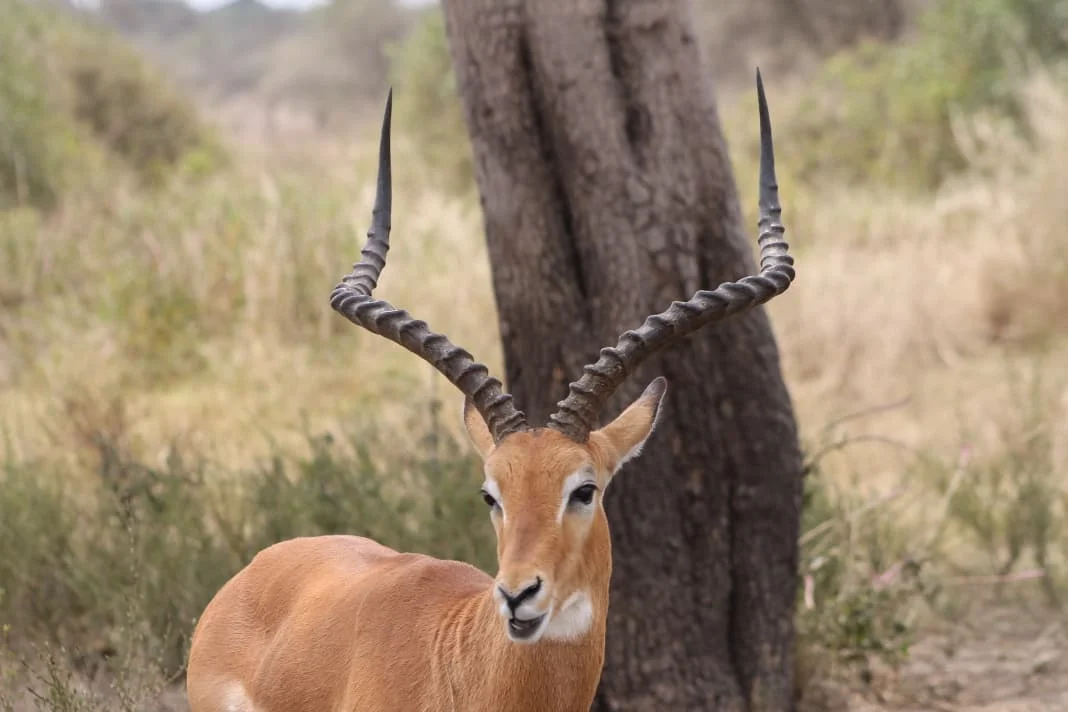
A male impala: use horns alongside body shape and markings when comparing species.
Impala vs gazelle: a frequent source of confusion
An impala is an antelope, but it is not usually called a gazelle. Its warm brown coat, pale underparts, and dark rear markings are useful to study. Adult males carry curved horns; females lack them.
AWF's impala profile sets out those features and describes its use of grassland and woodland edges. Ask your guide to compare the whole outline and markings with a gazelle. A quick look at colour alone is not enough.
Impala can make a quiet woodland-edge stop especially rewarding. Watch how the herd feeds and moves between grass and cover. The experience adds habitat and behaviour to the gazelle vs antelope comparison.
Wildebeest: a very different-looking antelope
The wildebeest's heavy front end, curved horns, and slimmer hindquarters give it a striking shape. It is an antelope too. Seeing one alongside small gazelles is a clear reminder of the variety within the broader grouping.
Do not confuse recognising the animal with predicting the migration. Wildebeest occur in different settings, and a river crossing is a separate event. A good safari gives time for quiet grazing scenes as well as larger movements.
Eland and waterbuck: broaden your field notes
Eland and waterbuck offer further examples of antelopes beyond gazelles. Let your guide help you compare build, coat, horns, and habitat when the opportunity arises. You do not need to learn every species before departure.
San Diego Zoo's antelope overview shows the range within the group. In Tanzania, use a regional field guide rather than assuming that every antelope in a zoo collection or online article belongs on your route.
Horns, antlers, size, and speed: which clues help?
In gazelle vs antelope identification, the strongest clue is usually a combination of features. Horns, coat pattern, size, and habitat can all help, while any one of them can mislead if the view is poor.
Horns are useful, but sex and age matter
Antelope horns are generally retained rather than shed each year. Deer antlers are normally shed and regrown. The San Diego Zoo Safari Park antelope page explains the distinction and the fact that horns may occur in one or both sexes, depending on species.
Do not turn that broad comparison into a field rule that every antelope you see must show large horns. Females and young animals can look very different from adult males. A broken horn can also make a familiar outline harder to recognise.
A smaller animal is not automatically a gazelle
There are small antelopes outside the gazelle group. A large gazelle can also be bigger than a small antelope of another kind. Compare like with like: adults, a similar distance, and a view that shows the body clearly.
If you cannot judge size, use the visible markings and habitat instead. Say what you can see before guessing the name. A note such as “small brown antelope at the woodland edge” is a useful start.
Do not use running speed as an identity test
There is no single gazelle vs antelope speed contest because the categories overlap and contain different species. A burst of movement tells you little about the exact animal. Focus on a safe view and let the guide explain the scene.
Never call, chase, or startle an animal to watch it run or jump. Natural feeding, resting, and social behaviour are worth seeing. A calm encounter often gives you a much better chance to learn.
Where can you explore gazelle vs antelope on a Tanzania safari?
A varied route gives you different habitats and more chances to compare Tanzania antelopes. It does not need to include every park. Time at a suitable base is often more useful than a long list of stops with little viewing time.
Serengeti: make time for the smaller animals
Exploring Serengeti wildlife gives you time to discuss gazelles, wildebeest, and other antelope with your guide. Its plains and changing habitats give context to the animals. Camp location and the part of the park you explore matter as much as the name of the destination.
The TANAPA Serengeti brochure describes gazelles alongside zebra, wildebeest, and other wildlife. A migration-focused trip can still leave time for smaller herds and careful observation. Ask for a pace that supports those interests.
Ngorongoro: distinguish the crater from the wider area
The Ngorongoro Conservation Area contains more than the crater floor. A crater drive and a journey through the wider landscape are different parts of an itinerary. Ask which habitats your route includes.
The Ngorongoro Lengai Geopark overview includes gazelles and other grazers among the area's wildlife. Use it as a starting point, then discuss where your guide can take you within the rules. Do not assume every species occurs in every part of the area.
Tarangire: add woodland-edge antelope
Tarangire can add a different setting and opportunities to learn about impala and other antelope. The official parks brochure hosted by Tanzania's embassy lists a varied antelope community there. An older species overview is useful context, while current viewing still depends on conditions.
Choose a mix of habitats if antelope identification is a priority. An open-grassland sighting and a woodland-edge encounter can teach different lessons. That is how a gazelle vs antelope question becomes part of a richer safari.
A simple field routine for identifying antelopes
Start with the animal's setting, then work through what is actually visible. You do not need to solve the name in the first few seconds. Use binoculars, ask questions, and allow for a view that remains uncertain.
Find the habitat: open plain, bush, woodland edge, or near water.
Check the outline: body size, leg length, head, and neck.
Look at markings: flank stripe, face, belly, rump, and tail area.
Study horns carefully: take account of sex, age, and the angle.
Compare a second view: a side and rear view can reveal different clues.
Ask the guide: explain which feature you used and listen to the reply.
Take a quick field note with the park, species if known, and one feature you noticed. A clear photo from the permitted position can help you review it later. Never seek a closer view that disturbs the animal.
Keep the gazelle vs antelope lesson simple for children too. First learn the broad group, then a few species. Give each child one feature to find, without making every sighting a test.
Sample safari packages to tailor with TanzaLux
These are sample route ideas, not fixed departures or guarantees of species. They can give you room to explore gazelle vs antelope in the field. Ask for current camp choices, park visits, fees, transport, meals, and all exclusions in a written quote.
5-day Tarangire and Ngorongoro Introduction
Day 1: Arrive in Arusha and settle into your hotel.
Day 2: Explore Tarangire, then continue to a Karatu-area base.
Day 3: Enjoy a planned Lake Manyara outing or a gentler highlands day.
Day 4: Take a crater drive and return to Arusha.
Day 5: Transfer for departure or an onward stay.
This is a compact route for a first look at varied habitats. Discuss your interest in antelope with the planner so the pace allows time for common species. Day three should be chosen for your interests and comfort.
Tailor a five-day northern safari with time to watch and learn about antelopes.
8-day Northern Circuit Wildlife Discovery
Day 1: Arrive in Arusha.
Day 2: Visit Tarangire and stay in or near the park.
Day 3: Enjoy more wildlife viewing, then continue to Karatu.
Day 4: Travel to a suitable Serengeti base.
Days 5–6: Explore Serengeti from the same camp.
Day 7: Return towards the Ngorongoro highlands for the night.
Day 8: Take a planned crater drive and return to Arusha for an overnight stay.
Schedule departure for the next day. This route adds time on the plains, with long transfers that can be adjusted through extra nights or suitable flights. Ask about the actual camp position for your dates.
Build an eight-day Northern Circuit journey around wildlife variety and a comfortable pace.
12-day Safari and Zanzibar Journey
Day 1: Arrive in Arusha.
Day 2: Visit Tarangire and continue to Karatu for the night.
Day 3: Take a crater outing, with another highlands night.
Day 4: Travel to Serengeti.
Days 5–6: Explore on game drives.
Day 7: Take a confirmed flight connection to Zanzibar and stay in Stone Town.
Day 8: Take a guided town visit, then transfer to the coast.
Days 9–11: Relax, with optional outings arranged separately.
Day 12: Transfer for departure.
Confirm flight stops, bag limits, and transfer times. Add a transit night if needed. Private road guiding does not make flights, boats, or all island activities private.
Combine a private Tanzania safari with Stone Town and a relaxed Zanzibar stay.
Why travel with TanzaLux Safaris?
TanzaLux Safaris is Tanzanian-owned and based in Arusha. The team shapes routes around your dates, interests, pace, comfort, and budget. Tell the planner that learning about wildlife matters to you, including the gazelle vs antelope question.
A private road safari gives your party its own guide and vehicle. Discuss longer stops, time for photos, and a gentle pace for family travel. Flexibility works within park rules, weather, and the agreed route.
Ask for a clear proposal showing where you stay, which parks you visit, and how the travel days fit together. Common antelopes can be as rewarding as headline predators when you have time to look closely.
Take the gazelle vs antelope lesson into the field with an open mind. Learn a feature, ask a question, and enjoy what the animals are doing. Good guiding and a thoughtful route can make that learning part of the holiday.
Share your wildlife interests with TanzaLux Safaris and request a personal safari plan.
Frequently asked questions
1. What is the main gazelle vs antelope difference?
Gazelle is a more specific group within the wider common grouping called antelopes. A gazelle can correctly be called an antelope. The broader word also includes many animals that are not gazelles.
2. Are all gazelles antelopes?
Yes. Gazelles belong within the antelope grouping. Learning the species name gives a more precise description, such as Thomson's gazelle or Grant's gazelle.
3. Are all antelopes gazelles?
No. Impala, wildebeest, waterbuck, and eland are examples of other antelopes. The broad group contains many different sizes, shapes, and habitat preferences.
4. Is a gazelle a deer?
No. Gazelles are bovids, while deer belong to a different family. Horns and antlers can help explain the distinction, but field identification should use several features rather than one distant clue.
5. Is an impala a gazelle?
An impala is an antelope, but it is not usually called a gazelle. Study the coat, rear markings, and overall shape. Males have curved horns while females do not.
6. Are wildebeest antelopes?
Yes. Their heavy front end makes them look very different from small gazelles, but they are part of the broader antelope group. This is a useful example of its variety.
7. Which gazelles should I learn for a Tanzania safari?
Thomson's and Grant's gazelles are good starting points for suitable northern routes. Ask your guide to explain a clear view of each. Sightings depend on where and when you travel.
8. How can I recognise a Thomson's gazelle?
Look for a small body, tan upper coat, white underparts, and a bold dark flank stripe. Use these with the rear and face markings. A single feature can be unclear in shade or at distance.
9. How does Grant's gazelle differ from Thomson's?
Grant's is generally larger, and its white rump patch extends above the tail. Markings can vary. Compare adults and more than one feature rather than making the decision from size alone.
10. Do female gazelles always have obvious horns?
No. Horn size varies with species, sex, and age. A female Thomson's gazelle may have small horns or none. Lack of large horns is not enough to settle the gazelle vs antelope question.
11. Do antelope shed their horns every year?
Antelope horns are generally retained. Deer antlers are normally shed and regrown. Do not confuse that distinction with a claim that every antelope you see must have large, visible horns.
12. Are gazelles always smaller than other antelopes?
No. Some other antelopes are very small, and species overlap in size. A young animal can also confuse the comparison. Use build, markings, and habitat alongside any size estimate.
13. Which is faster in a gazelle vs antelope comparison?
There is no single winner because gazelles are antelopes and both labels cover more than one species. Identify the actual species before asking about speed. Never disturb an animal to watch it run.
14. Do all antelopes eat the same food?
No. Diet and the balance of grazing and browsing vary between species and seasons. Ask what the animal in front of you is eating. Habitat and feeding behaviour add useful context to its identity.
15. Where can I learn about gazelles in Tanzania?
Serengeti and suitable parts of the Ngorongoro area are useful places to discuss with your planner. Choose camp locations and enough viewing time for your interests. No park visit guarantees a particular species.
16. Why add Tarangire to an antelope-focused route?
It adds different habitats and opportunities to compare other antelopes, including impala. A varied route helps show the wider group. Check the exact park days and driving time before booking.
17. Can I identify an antelope from one photo?
Sometimes, but a distant or partly blocked view may be inconclusive. Keep the original image and note the place and date. Ask your guide which features support the identification and which remain unclear.
18. Can children understand gazelle vs antelope?
Yes. Start with the idea of a smaller group inside a larger one, then learn one species at a time. Ask them to find a marking from the vehicle, without making the outing a constant quiz.
19. Do I need special gear to compare species?
Binoculars and a suitable regional field guide can help. A notebook or phone note is useful too. A safe, calm view and a guide's explanation matter more than getting very close.
20. How can TanzaLux help with a gazelle vs antelope safari?
Share your interest in learning and the pace you prefer. The team can tailor a route with varied habitats and time for questions. Wildlife encounters remain natural and cannot be guaranteed.
Ready to start planning?
Tell us your dates and what you're after — no obligation.